Graz is the Austrian city that many travellers from Central Europe reach before they ever need a long-distance train to Vienna. It sits on the Mur, close to Slovenia and to the hills of Styria, with a historic centre that has been on the UNESCO World Heritage list since 1999 and a design reputation formally recognised in 2011, when Graz became a UNESCO City of Design. The combination is the point: this is not a city that froze in the Baroque, nor one that threw the old town away. You walk from a courtyard and a clock tower to a blue, blob-like museum on the river, and both feel as if they belong.
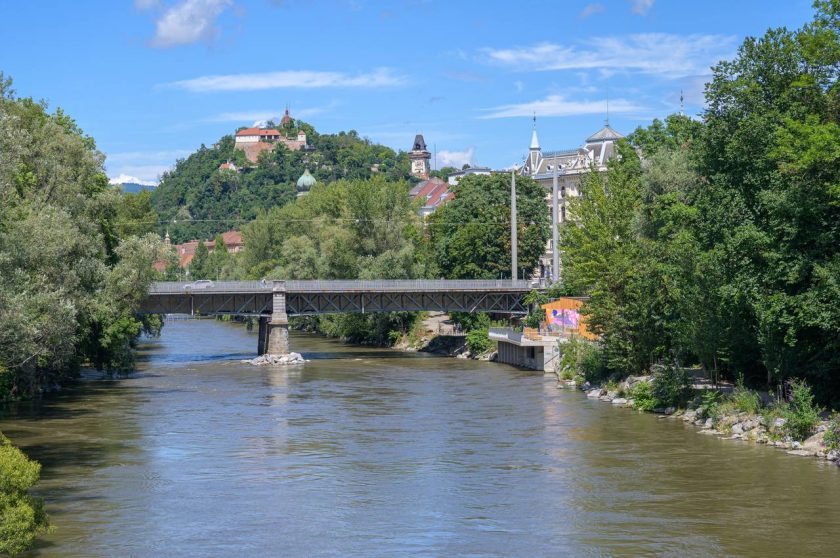
The Schlossberg is the place to start, and it does not require a ticket simply to walk the hill. Allow time, officially a couple of hours if you want the paths, the views and the landmarks rather than a single photograph. The Uhrturm, the clock tower, is the city’s emblem; the bell tower and the rambling trails across the rock give you Graz from above, with the Mur below and the roofs of the old town in between. You can walk up, or use the Schlossbergbahn funicular or the lift, both of which are practical if you are not climbing on a hot afternoon. Current hours and fares are on the operators’ and graztourismus.at pages.
The hill is a park as much as a viewpoint. It is free, popular, and still worth it, especially early or late in the day, when the terraces are quieter and the light is kinder to the roofs. You do not need to “do” every monument on the rock. The walk and the view are the visit.
The old town, courtyards and the Kunsthaus
Below the hill, the historic centre is a city of passages and courtyards, of arcades you can step into and of squares that remain living market and café space rather than a fenced-off set. That everyday use is part of why the UNESCO listing still feels convincing. Walk slowly. Look through doorways. The official tourism site is honest about this being a city to wander, not to tick off in a rigid hour.
On the river stands the Kunsthaus, nicknamed the Friendly Alien: a contemporary exhibition building that has become as recognisable as the clock tower. It is not open every morning of the week; the standard pattern at the Universalmuseum Joanneum is Tuesday to Sunday, with Monday typically closed, but you should confirm hours and tickets before you go. One serious exhibition, plus the building itself, is a better plan than a rushed walk-through on the way to lunch.
The Mur is the city’s other main street. Paths along the water, the island and the bridges give you a pause between museums, and they are an easy way to see how compact the centre is. Graz rewards staying overnight. The old town in the early morning, before tour groups fill the main squares, is a different city from the same streets at mid-afternoon.
Eating, moving and a slower pace
Styrian food is part of the reason to come: pumpkin-seed oil, seasonal vegetables, wine from the nearby hills, and cafés that still take a sit-down coffee seriously. You do not have to hunt for a once-in-a-lifetime reservation to eat well, but in the very centre a booking at dinner is still wise. Markets and the sidestreets often offer a more local table than the first terrace on the main square.
The centre is walkable. Trams and buses cover the rest; tickets are sold through the city’s official channels. A car is more of a hindrance than a help in the historic core. If you arrive by train, you are already in a useful position, with the old town and the river a manageable walk or a short tram ride away.
An easy city from Slovenia
From north-eastern Slovenia, Graz is one of the simplest foreign cities to reach, by car or by train, and from Ljubljana it is still a comfortable day trip or a short overnight. If you drive, remember that Austria has its own motorway vignette, which you must buy before you use the motorway network, and that Slovenia’s e-vignette does not cover it. Times and connections change, so check the current train timetable rather than an old blog post.
Graz is a good city for travellers who have already seen Vienna, or who want an Austrian visit that is urban without being overwhelming. Give it a night if you can, climb the Schlossberg when the light is low, and leave time for a courtyard you did not plan to find. That, more than any single museum slot, is what the city does well.